Signatures to date.
If you have any comments, news or articles relating to Moon Bears that you would like to share on this page please do not hesitate to contact us (please include your signature number).
Click on the News Headline to view or hide the associated article.
You may also Expand all articles and Return to Headline view.
moonbears.org is very pleased to announce that finally we have managed to flag officially in correspondence coordinated by WSPA the concept of a sanctuary for freed bears in Korea.
Up until now it has been difficult to get consensus from interested organisations that Government should be asked to consider such sanctuaries so it is quite a breakthrough to have this reference in the letter.
In our next update we will publish the letter itself.
Today there are 16 bears left in the wild- confirmed by Jirsan moon bear species restoration centre.
June12, 2010, a 4 year old male bear had been found dead by the centre team being poisoned- suspected by a farmer near by. After autopsy, the amounts of poison found in his body exceeded a lethal dose by 40 times.
Another 6-year-old female named Lang-lim was found dead hanging on a tree by a trap on June 29. Farmer Choi (71) from a near by village was arrested and charged for placing the trap.
Lang-lim was brought from North Korea and gave birth to a cub last year for the first time. According to the specialists, this threatens the baby’s survival.
Moonbears.org urges the Ministry of Environment to educate villagers on the importance of the species restoration project and compensate farmers in the village as this holds the key to success of the Jirisan project.
By way of contrast, compared to those in the wild there are 1,140-farmed bears across the country in 66 bear bile farms today.
http://news.sbs.co.kr/section_news/news_read.jsp?news_id=N1000764616
ANIMAL ASIA FOUNDATION MEDIA RELEASE~
21 July 2010
Vietnam's highest-ranking traditional medicine practitioner has warned consumers to stop taking bear bile products or risk liver and kidney damage - even death.
Doctor Nguyen Xuan Huong has joined Animals Asia's campaign to end bear bile farming after seeing the shocking effects of bile consumption on some of his patients, including two government officials who died after taking bear bile tonics.
Dr Huong, who is Chairman of the Traditional Medicine Association of Vietnam - and carries the title of People's Doctor the highest ranking position in the country's medical profession - has treated 10 patients for bear bile poisoning since 1985, including two he couldn't save. Dr Huong's last bear bile patient was in 2006 - a 55-year-old male from Hanoi who had consumed too much bear bile and was jaundiced. Dr Huong's diagnosis was damage to the liver caused by the bear bile. He successfully treated this patient, but for others it was too late.
When the Director of Construction in Quang Ninh Province came to Dr Huong in 1995 it was already too late - his skin was yellow, he couldn't walk or talk and he had severe cirrhosis of the liver. He died two weeks later aged 50. The director had consumed bear bile mixed with wine for virility.
Dr Huong's second fatal case was in 2002 - a 75-year-old Hanoi doctor, whose son kept bears, had taken 2cc of bear bile mixed with wine as a health tonic. By the time he arrived at Dr Huong's Hanoi clinic, his body was covered in dark patches and his fingernails and toenails had turned black and later fell off. Dr Huong treated the man for a year with herbal medicine to increase the function of the liver, but his organs were two severely damaged and he died from the poisoning. He said the man looked similar to the man in the attached photo, who was also being treated for bear bile poisoning.
"In each of these 10 cases, all had damage to the liver and in most cases, the liver was almost gone - the part that was left was swollen, necrotic and hard," Dr Huong said. "Bear bile also causes kidney failure." He said other symptoms included loss of appetite, fatigue, red eyes, aches and pains in the body, blood in the urine and severe dehydration and perspiration.
Dr Huong said bear bile was rarely used in authentic traditional medicine and was more likely to be sold as a quack "cure" for hangovers or impotence. "I've read 17,000 traditional medicine formulas and only six mentioned the use of bear bile and even then, its use is minimal and it has little effect. People should never use bear bile - even for complaints such as fertility and strengthening the body. Eighty per cent of those consuming bear bile will have liver damage from drinking even 2cc, and if you mix it with rice wine, the damage will be worse."
Dr Huong, who served two terms in Vietnam's National Assembly, has repeatedly raised the issue in the assembly but failed to make an impression. "Even highly educated people still don't understand the dangers. Bear bile serves a purpose in bears - it aids in their digestion, just as human bile aids in our digestion. It goes against nature for humans to consume bile from bears; it attacks the organs - and the bears' become ill when their bile is extracted. "Bile is obviously different in each species and is there to serve the animal in whose body it exists."
Animals Asia Founder and CEO Jill Robinson said she hoped Dr Huong's decision to go public would prompt health and customs authorities to look urgently into the risks of bear bile consumption. "Korean tourists are lining up to visit bear farms in Vietnam on organised bus tours, many leaving with vials of fresh bear bile as a hangover cure - and bear bile is sold on the black market in Chinatowns around the world. The longer it takes the authorities to act, the more people will fall ill and possibly die."
Dr Huong qualified as a traditional Chinese medicine (TCM) practitioner in 1972 after starting his studies in 1965. He boasts 16 generations of family working in TCM. Dr Huong studied for six years at the Beijing University of TCM.
Animals Asia's Vietnam Director Tuan Bendixsen said that while bear bile extraction was illegal in Vietnam, lack of enforcement meant the practice was still widespread. The bears are drugged - usually with the illegal drug, ketamine - removed from their small cages, restrained with ropes and jabbed in the abdomen with four-inch needles until the gall bladder is found. The bile is extracted with a catheter and medicinal pump. There are currently over 4,000 bears on farms in Vietnam.
In November 2005, Animals Asia signed an agreement with the Vietnamese government to rescue 200 bears and care for them at our Vietnam Moon Bear Rescue Centre in Tam Dao National Park. Our rescue centre is currently home to over 60 bears confiscated by the government and is ready to receive more bears rescued from bear farms.
Dr Huong is available for interviews in Vietnamese and Chinese. Mobile: 0913 059211; Clinic: 04 8472515. English translation can be arranged through Animals Asia. Dr Huong's comments in this press release have been translated from Vietnamese.
Green Korea urges the Korean government to end the 30 year history of bear farming policy in the country.
On July 9 at the National Assembly Seoul, Green Korea successfully held a special exhibition inviting 30 guests from all different areas - including members of the National Assembly, doctors of Korean Traditional Medicine associations and executives of the bear farmer's association. The exhibition ended with invited guests putting bear foot prints in ink on a white board with the title 'Passage to a Freedom'. Each guest was also invited to write a comment alongside their 'print'.
Ms Kim Miyong - the bear team manager of Green Korea added a message arguing that it is now time to act to end the 30 years of agony and for the Government to change its policy on the bear farming issue and to legislate to ban the bear farming industry.
Mr. Yeom, Kwang-ho, the Chairman of the Bear Farm Association also expressed his hope that the Korean government will buy all 1140 farmed bears across the country. He said the total cost of compensating bear farmers would be around 20 to 30 billion won (20 to 30 million dollars) - asking a minimum of 17.5 million won per a bear. Since the bear farmers are also responsible for making the wrong decision from the beginning - this figure seems impossible to be met by the Korean government when the compensation process eventually starts.
Of course none of these figures include the cost of moving the bears to sanctuaries to see out the rest of their days. But this action by Green Korea is a wonderful start.
Again, well done Green Korea!
For those who are interested in more stories, please click the following link-
http://www.ihknews.com/news_PDF/news20100708.pdf
For those who wants to help Green Korea's stop bear farming law campaign, please go to the following link-
http://bear.greenkorea.org/sub04/04_view.asp?ntNo=40
http://bear.greenkorea.org/sub04/04_view.asp?ntNo=39
http://bear.greenkorea.org/sub04/04_view.asp?ntNo=38
Download page has been specially created for the posters to stop Korean bear farming industries. Please visit.
Miracle news- it has been a year since we posted news on our 'Miracle' bear. More updates is coming soon.
The spokesperson Ms Jie-ae Sohn
The former CNN correspondent to Korea, Jie-ae Sohn, has been appointed by the Korean Government as their official spokesperson for the G20 meeting in Korea in this coming November 11 and 12.
We would like to encourage everyone to contact Ms Sohn and express outrage about the Korean Governments policy on farmed bears.
The G20 is a time when Korea wishes to show it can be a global leader economically but the point needs to be made that it is lagging far behind the rest of the world on such basic things as animal welfare.
If any readers are in contact with people coming to Korea for the G20- particularly politicians or diplomats, please let me know at g.moon@moonbears.org
moonbears.org invites all of you to celebrate this remarkable day with us.
For anyone wishing to read a recent article on Ms Sohn's appointment please see the link to a Korea Herald article below. Her twitter account is g20jieae.
http://koreaherald.heraldm.com/national/Detail.jsp?newsMLId=20100404000230
http://www.womennews.co.kr/news/44193
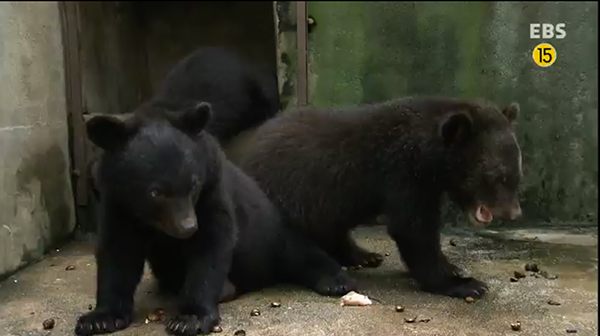
It has been confirmed that there are now a total of 19 moon bears in the wild (excluding one born in the breeding centre).The above photo shows new born cubs- male and female -in the wild found on February 23, 2010. Each cub was 2 months old, weighed 1.5kg each and was confirmed to be healthy.
According to Mr Yoon-su Lee (centre manager in the media department), the number of traps they collect from the Jirisan national park has decreased over the years.This is very good news.
The team do trap inspections weekly and Mr Lee didn't release the statistics of the exact number of traps collected in order to avoid unwanted criticism by the public.
The traps, usually placed by villagers, are actually designed to catch wild boar to reduce damage but unfortunately released moon bears have in the past been trapped instead.
Traps have always been one of the biggest issues that the centre has had to overcome to revive the moon bear population in the wild.
The following video is about the new cub-born on February 03, 2010- at the Jirisan centre. The mother was imported in 2004 from Russia and released to the wild but returned after failing the program. She gave birth to the cub 6 months after her return. The cub will stay with her for another 6 to 8 months and will be released into the wild by October 2010.
This video footage is valuable in that it shows interesting information on the mother looking after its cub after birth. Jirisan moon bear restoration centre is planning to increase the number of moon bears in the wild to a minimum of 50 in the future. This is wonderful work by all involved.
moonbears.org has become a part of World Animal Day celebration in Korea, 4th of October, 2010.
The Wold Animal Day is set up to connect millions of animal lovers and to unite the animal welfare movement throughout the world embracing all animals and and the unique concerns of each, in every country.
moonbears.org invites all of you to celebrate this remarkable day with us.
http://www.worldanimalday.org.uk/Ambassadors/Webpages/Korea-GinaMoon.asp
moonbears.org has sent an official letter to Korea's President, Prime Minister, Minister of Environment, Minister of Knowledge Economy.
The letter explains our belief and reason why the Korean government should end the bear farming industry and build bear sanctuaries to care for the farmed animals.
We do not believe in slaughtering bears to phase out the farming industry but would rather find a good solution to benefit everyone in a long run.
moonbears.org believe the government decision making before Korea hosts the historic G20 meeting in Korea in November this year, 2010.
Please support our belief and help us spread word.
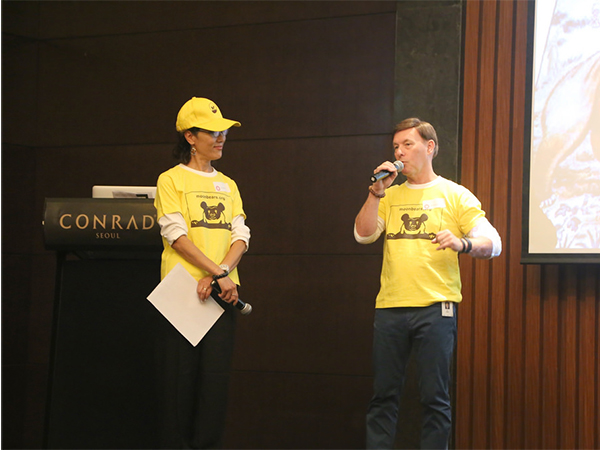
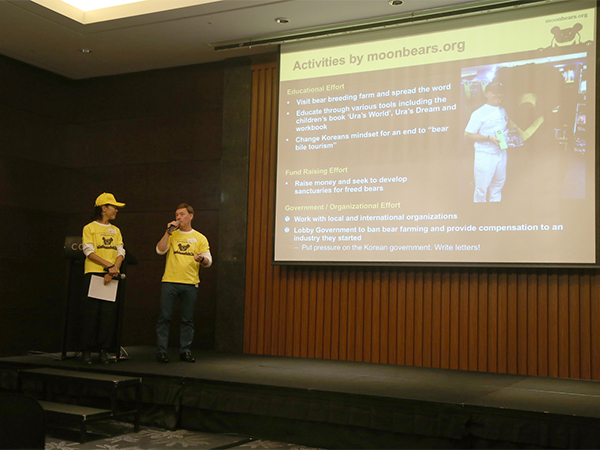
moonbears.org gave a presentation in Advancing Bear Care Conference, San Francisco on 08 November, 2009 to talk about sad reality of Korean farmed bears for the first time on the international stage
It was truly an eye opening and breath taking experience for us- moonbears.org to learn there are many wonderful, caring people out there sharing their life time experience with others.
Read More
Some Koreans have a seemingly endless appetite for products that promise to boost their health or sexual prowess, prompting them to eat food items that would seem unconventional by Western standards. One such product is bear bile, known in Asia for its medicinal properties. To get it, a significant number of Koreans are traveling to bear bile farms in Vietnam, where they can buy bile extracted from moon bears raised in cages. The problem is that many of these Korean travelers are unaware that such activities are illegal in Vietnam.
Read More
By Moon Gwang-lip [joe@joongang.co.kr] From Joongang Daily
Recently, Oct 27 marks the big time for us: our petition has hit 10,000 signatures! Thank you very much for all of your support, it means so much for us. It was also signed by Ms Sue Prince from UK. As we are half way to our goal to collect 20,000 signatures, we need to celebrate this great achievement. We hope this event will circulate throughout communities and people can take the petition as an educational tool on how to protect Moon Bears. Your support is vital in order to make this petition a success.
Moonbears.org would like to recognize Nicola Goddard for her tremendous work in creating the following lesson plan, to help Korean children learn about the bear bile issue and to give them a chance to have their voices heard. Nicola also arranged for her class to write letters to President Lee Myung Bak, urging him to put a stop to bear farming. Great work Nic, we feel fortunate to have your support!
Resources
*Comprehension - Miracle
*Jasper's Journey
*Meet the Moon Bear - Powerpoint
(Right click and select 'save as'.)
Part 1.
Part 2.
Part 3.
Sadly she is no longer with us, thank you Kelly!
Contact information for Ministry of Environment: Minister Lee Man Ee
88 Gwanmoonro, Gwacheon-si, Gyeonggi-do, 427-729, Republic of Korea
Phone: 02-2110-6546
Fax : 82-2-504-9206
Contact information for Blue House: President Lee Myung Bak
1 Cheongwadae-ro, Jongno-gu, Seoul, South Korea 110-820
Email: foreign@president.go.kr
Phone: 82.2.730.5800
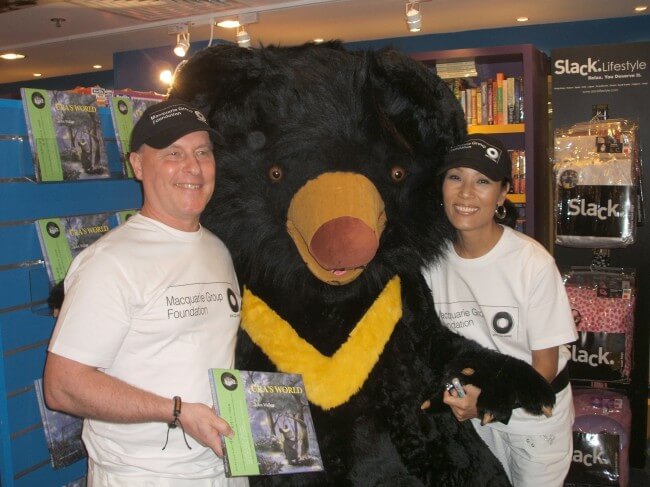
This month, John Walker announced his second donation of 'Ura's World' proceeds to Shawn Morrisey, Founder and Ceo of the Korean Mountain Preservation League. Moonbears.org is proud to help John succeed in his goal to continually support Korea's environmental organizations. The Korean Mountain Preservation League (KMPL) is committed to work as a non-governmental, non-profit organization to help preserve Korea's highlands. We are pleased to call them partners in our struggle to stop bear bile farming. Great work John!
On Monday, June 22, Gina paid a visit to the farm from which 'Miracle' escaped and had a conversation about the bear with her former keeper. We now know that our amazing bear is approximately 3 years old. She is not necessarily a Malay bear but POSSIBLY a Korean moon bear, though the farmer used the term Himalayan bear. Further research must be conducted to find the truth."
Miracle was born in a breeding farm in 2006 May.
The farm is a small scale operation, run by a Korean couple in their mid to late 60s, and time is running out for them. The industry made the farm owners rich but they are getting old and have medical issues. Farm owner Lee claims he doesn't care to continue his business and wishes for someone to buy all his bears from him.
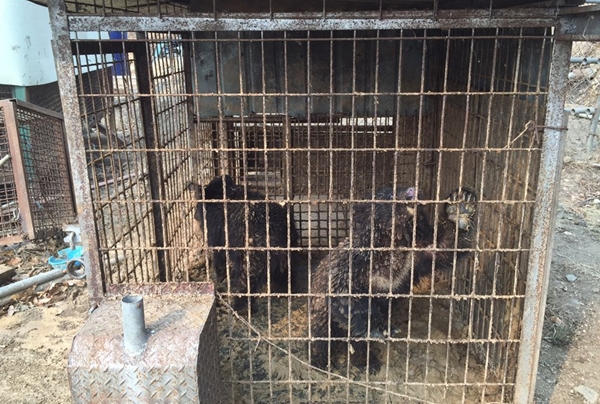
The farm is small, filthy and dry, and lacks any indication of cleaning or preservation efforts. The bears are fed pig’s food, though in the past, they have been given bear meat when available. This sort of diet is extremely unhealthy and inadequate for the animals. Not a drop of water in sight!
All resident moon bears can be seen sitting in their own feces, looking utterly lifeless. The Farms 4 bear cubs live in separate cages from their parents and are 5 months old. Also present is one 3-legged moon bear that is kept isolated in a small cage- obviously traumatized, and moving endlessly, showing his temper. He is a young bear cub of approximately one year.
The facilities look old and unkempt and the farm is not locked, but is secured by a wire, which tells us these bears were never let outside.
The farmer Lee said he told the officials clearly from the beginning that he doesn't want Miracle returned to his farm when she is captured. Therefore, we can assume the words we had previously heard from Wonju Representatives were empty as officials claimed that they must return Miracle because of the private property laws in Korea.
It is obvious that there have been no efforts by the environmental Ministry to regulate the farm, or to enforce the law by authority of the Environment Ministry.
Lee's registration documents showed no pictures of the individual bears, making it impossible to distinguish one bear from another.
He started this breeding business in 1990 with the purchase of moon bear pairs; now he owns a total of 16 bears- 12 males and 4 females.
According to Farmer Lee, Miracle seems to be a Korean moon bear, though she was previously assumed to be of Malaysian breed as is often the case with farm bears.
She escaped from her terrible fate through a hole in fencing when she was 16 months old in September 2007 and have lived in wild ever since. She swam across a river, which is at least 400 meters wide with a strong current and finally found her freedom.
The damage reported from the nearby farms is minor; it includes a couple of honey pots and some chicken food on 2 separate occasions. This proves that she has been living on her own, adapting to her surroundings with no external aid; an amazing feat from an ecological point of view.
Farmer Lee is quite a gentle guy, and seemed very pleasant, though it is obvious he's been a little inconsistent in his information. Aside from his bear business, he runs a deer farm, which located out in the front of his property while the bear farm is hidden in his back yard.
Despite his background, Farmer Lee is quite likable - but he creates pure Purgatory for all of us including himself, because he has admittedly been selling the bears, regardless of age, to anyone who asks (for their gal, for their meat, for their paws.. or even for bile milking farms) and his sole interest is financial gain.
He doesn’t contemplate their pain or death; he feels free of moral responsibilities.
The Environment Ministry of Wonju showed sensitivity toward the issue- they want to keep it quiet so the stories remain out of the public eye.
The plan of capturing the bear and warning the public involved 5 separate attempts. Traps had been used along with warning signs being distributed to public. A dart gun was not considered simply because they didn’t have one and lacked expertise.
Instead, professional hunters and hunting dogs were used - 30 hunters with 10 dogs in their first trial and recently, 110 people with 40 hunting dogs in May this year for a 10 day period. The Jirisan Moon bear population restoration center also participated in this project at some point but with no success.
Plans to capture Miracle have been suspended until this autumn when food supply gets low and the forest becomes thinner.
However, the Wonju office has prepared them to act more swiftly when the report comes in from the villages by creating a communication and emergency contact network.
Despite these efforts, we can't deny the feeling that in their documents, there is an absence of scientific involvement.
Now it is very important to us that Miracle is captured and saved.
She belongs to wild as she earned her life by living it. A sanctuary plan is now urgently needed. We have options, but we must take initiative to see that Miracle is found and placed in a safe environment.
Miracle is indeed a miracle- our first hope for saving the entire population of farmed bears in Korea and for the rest of the world.
The fate of “Miracle,” a female Asiatic Black Bear (Moon Bear) that escaped from a Whacheun Province bear bile farm in September, 2007, is currently being deliberated by Wonju District officials.
Unless officials decide otherwise, Miracle will be returned upon capture to a body-sized metal cage like the one from which she escaped, at the same bile farm where she spent her life before escaping. Environmental and animal welfare groups are working to see that this does not occur.
Poorly adapted to living in the wild, Miracle has so far managed to survive while wandering the Chuncheun border region by feeding from farmers’ crops.
Miracle had been deemed a potential threat to tourists, and orders had been given to kill her on sight until June 1st, 2009, when the “kill-on-sight” order was retracted and Wonju Office Officials began debating how to manage the bear.
Citizens of Wonju argue that the bear ought to be captured and re-introduced into the Wonju wilderness after research concerning her health status, behaviour, and genealogy are conducted. As a captivity-bred individual, Miracle is significant in that she has successfully introduced herself into a wilderness despite a lack of survival skills education, which would have occurred had she been raised by her mother in the wild.
At this time, it is uncertain whether Miracle can be thus reintroduced into Korea’s Jirisan National Park because the presence of hybrids is seen as dangerous to the preservation of pure breeds. Until the appropriate research is completed, it is unknown whether Miracle is a hybrid or a pure Asiatic Black Bear.
Unfortunately, at this time there is no suitable sanctuary or rescue centre for mixed-breed bears in Korea. Options for Miracle may include: granting the wish of the Wonju Villagers to release her deeper in the wild, a temporary placement in a zoo or a private location on farmland where she would be protected from hunters.
The Asiatic Black Bear, or “Moon Bear” named for its distinctive crescent-shaped marking on the chest, is a protected species in Korea. Only eleven (11) moon bears reside in the Korean wild, while an astounding 1600 are barely living under the torturous conditions of bear bile farms in Korea, where they are kept in body-sized metal cages from an early age in support of the bear bile industry.
Ursodeoxycholic acid, or “UDCA,” is the prized ingredient in bear bile and is believed to treat numerous health ailments. There are 54 known herbal alternatives to UDCA, all of which are acknowledged by the scientific community. Nevertheless, bear bile farming continues in Korea, China, and Vietnam.
www.Moonbears.org, a group of people campaigning in Korea for the freedom of moon bears, urges friends of animals and the environment worldwide to show their support for “Miracle” and other Moon Bears by writing letters to the following officials:
1. The Minister of the Environment -
Attention:
Mr. Lee Maan-ee
KyungGi-do, GwaCheun-si, KwanMun-ro 88
JungAng-dong 1, GwaCheeun complex, (427-729)
For all those who have been looking for the contact details of South Korea's president here they are:
President Lee Myungbok
1 Cheongwadae-ro, Jongno-gu, Seoul, South Korea 110-820
Seoul, South Korea 110-050
Email: foreign@president.go.kr
Phone: 82.2.730.5800
Milking the Moon Bears: Bear Farming in South Korea
By Carly Nugent
You’ve probably seen the bus stop billboards around Seoul – big furry faces and wide, brown eyes. But apart from such advertising on behalf of groups like Green Korea, the issue of bear farming in this country receives little publicity. It is rarely discussed among the Korean community, and most expats are surprised to learn that the slaughter of bears even occurs here. Even the minister for environment was recently rumoured to have said, in response to questioning about bear farming, ‘is that still going on?’
It is going on, and it is legal. There are an estimated 1600 bears on 110 farms, most of them around Daegu – South Korea’s medicinal capital. Bears are farmed for their gall bladders and bile – used in traditional Asian medicine to cure numerous ailments such as fever, liver disease, poor eyesight, gallstones and even heart disease. While it is true that the extract from bear bile – ursodeoxycholic acid or UDCA – has proven to be an effective treatment for such illnesses, there are at least 54 readily available herbal alternatives. Herbal medicine is just as effective as bear products, not to mention cheaper and safer. Draining bears for their bile can be a risky process, especially if, as often happens due to unsanitary conditions, the bears are sick or the draining site is infected. For consumers seeking to get well, taking bear bile could have the opposite effect.
The selling of bear products is a lucrative trade – which could explain the reluctance of bear farmers to recognise the benefits of alternative medicine. A kilogram of bear bile can fetch up to USD $500, while a single gall bladder can be worth USD $10,000. Statistics indicate that 38% of oriental medicine shops in Korea carry these products – discreetly – in the form of pills, plaster or raw bear bile. Another common practice is the choosing of your own bear, directly from a farm, for slaughter.
While slaughtering bears for medicine is legal in Korea, milking them for bile is not. Animal rights groups, however, believe that a lack of government regulation or inspection of bear farms allows this practice to happen frequently. The process of milking a bear for its bile requires the insertion of a catheter into its gall bladder. When the bear is not being milked the catheter is removed and the site is covered by a steel lock and plate, designed to prevent tampering by the bear. This is not only uncomfortable for the animal, but can cause serious infection. Reports of the general treatment of farmed bears are also not positive. Bears are often kept in small, dog-sized cages, or sometimes crammed into larger cages with up to ten other bears. Their teeth are filed, and they are fed pig slop – far removed from their usual diet of vegetables and insects. Because of their living conditions bears are unable to hibernate, a fundamental instinct that, when repressed, results in depressive behaviour such as turning in circles, chewing the bars of cages, and self-harm. While the legal age for the slaughter of bears has recently been reduced to 10 years old from 24 years old, farmers are pushing for it to be lowered further, and there is no regulation on how bears are killed. Animal rights groups believe slaughtering practices, as a result, are often inhumane.
The majority of farmed bears (85.3%) are Asiatic Black Bears – also known as Moon Bears due to the crescent moon shaped pattern on their chests. Moon Bears are native to Korea, and are hailed as Korean National Monument Number 329. Since 1982 Moon Bears have been a protected species, and legend has it that Korea’s first king, Tan-gun, was born to a bear. Korea’s respect for its bears, however, is at odds with its penchant for farming them. Today, there are only about 11 bears left in the Korean wild as part of Jirisan National Park’s Moon Bear restoration work, and even these bears face the threat of poaching. Even more contradictory was the Korean government’s decision to join CITES (The Convention of International Trade in Endangered Species of Fauna and Flora) in 1993. CITES bans the international trade of bear parts, however it does not regulate domestic trade. As a result, Korea can no longer import bears from countries such as North America, nor can it export bear products. The domestic market, however, remains active. Joining CITES has also done nothing to discourage tourists from Korea travelling to China and Vietnam to purchase bear products. According to Education for Nature Vietnam (ENV), Koreans make up the majority of visitors on organized tours to bear farms in China and Vietnam. Bear farming in Vietnam is illegal - however an estimated 700 tourists visit undercover farms every week. Smuggling bear parts to Korea from Vietnam is a violation of the CITES agreement, but little is being done to stop this from happening.
The Union of Korean Bear Farms is currently pushing for further deregulation of bear farming practices. The Union Chairman Kim Mu-ung – whose name in Chinese ironically means ‘no bear’ – farms over 200 bears. He has petitioned the Korean government to legalize the sale of bear meat, and is rumoured to be planning the opening of a bear theme park. Kim argues that deregulation of bear farming will allow Korean farms to compete with China, discouraging the purchase of foreign products and improving local trade. Such an argument, however, does not address the treatment of the bears themselves – seeing them as valuable only for their commercial use. It has also been argued that the farming of bears protects the animals in the wild – however, this does not take into account the fact that poachers are selling wild bears to farms.
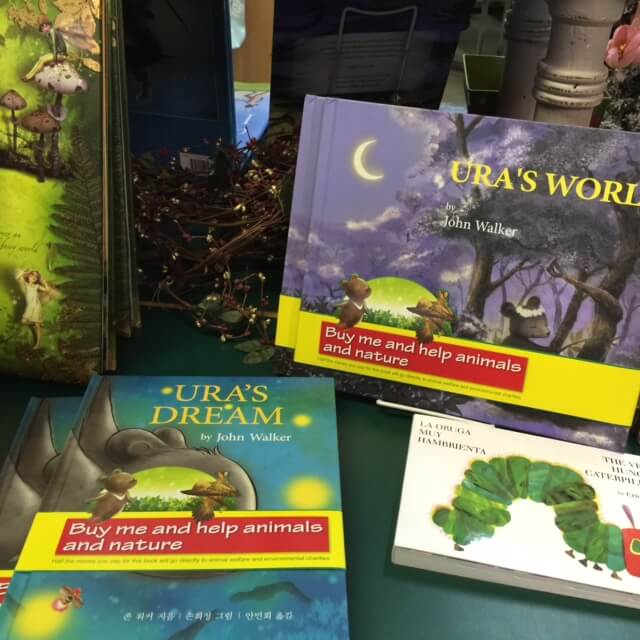
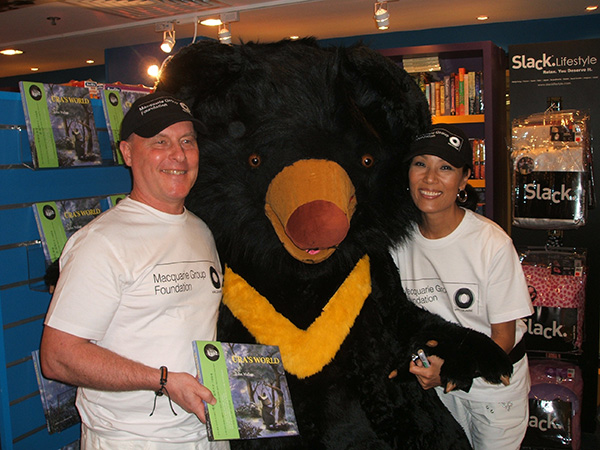
There are a number of groups that are working towards the protection of Korea’s farmed bears. Moonbears.org is a non-profit organization that was founded by Gina Moon in 2007. The Moonbears.org website has a link to a petition against bear farming, as well as up to date information about the issue. Moonbears.org is working towards the development of a bear sanctuary, in conjunction with the Animals Asia Foundation (AAF) – a Hong Kong based animal welfare charity founded by Jill Robinson in 1998. John Walker, a supporter of Moonbears.org, recently published a children’s book about the plight of Korean Moon Bears. The book – ‘Ura’s World’ – is set in South Korea and aims to remind readers of the importance of protecting flora and fauna.
Moonbears.org works with Green Korea United – an NGO focused on the preservation of Korea’s natural environment. Green Korea, apart from being responsible for Seoul’s Moon Bear bus stops, has investigated numerous pharmaceutical markets in Korea to expose the illegal international trade of bear parts. Green Korea has called on the minister for environment to restore the population and preservation of bears in the wild. They also meet with WSPA (World Society for the Protection of Animals) each year. WSPA are an international organization working to eliminate the illegal trade of bear parts. WSPA believes that the farming of bears is cruel, unnecessary and must end, and they are working with Asian governments as well as practitioners of traditional medicine to make this happen. They have had some success elsewhere in Asia - Vietnam committed to phase out bear farming in 2005 - and their goal is to achieve similar results in Korea.
Although there are reports that the market for bear gall is rising in Korea, there are indications that a lot of farmers would be more than happy to give up their trade. While around 30 farms house fifty or more bears, a 2007 survey carried out by Moonbears.org indicates that the majority of bear farms are small, backyard operations with less than 4 animals. The cost of keeping so few bears in most cases outweighs the profits, and many farmers see the animals as a burden rather than a financial asset. The question is - how much resistance would the closing down of the bear farming industry really face? If groups like Moonbears.org are well supported and continue to petition the Korean government, it seems a real possibility that the farming of this protected and revered species could soon be a practice of the past.
| This month, John Walker is proud to announce his first donation of KRW 2 M to Green Korea United. John's goals include the continual funding of Korea's environmental organizations. Green Korea United, one of the largest environmental organizations in Korea remains our proud partner in ending the bear bile trade. We are grateful for their on-going support. Great work John! Onward Ura! | ![]() |
(April 30, 2009) John Walker, Chairman of the Macquarie Group of Companies (Korea) wrote the children’s book ‘Ura’s World’. Korean and English versions have been simultaneously published.
Its setting is the beautiful country of South Korea, where there were once many moon bears in the wild. In fact a bear woman, “Ung Nyeo”, is, by folk lore from the story of Dangun Shinwha, the mother of Korea. This book is the tale of Ura and his friends in the Korean mountains.
Mr. John Walker came to Korea in year 2000 to establish this business. Macquarie is the largest foreign investment bank in Korea and has made investments into assets with a total value of 18 trillion won. Prior to being an investment banker, Mr. Walker was a very senior Government official in Australia. He wrote this book while on business trips as he was thinking about the beauty of Korea’s nature.
John Walker said, “I have a strong interest in Korean culture and nature. I would love two things to be achieved by those who read the book. Firstly I hope that young Koreans who are studying the English language will find it helpful through identifying with their own animals and mountains. Secondly I hope that all readers will be reminded of the beauty of Korean nature and the importance of protecting its flora and fauna. Also, this little book is dedicated to all those tireless people who give their lives to improving and protecting our natural environment.”
Sohn, Hee-Jung in charge of the illustrations in the book previously worked in the movie industry. Her interest in children’s books has motivated her to participate as an illustrator for the first time.
Published by Design EUM, 40 pages - 8,000 won per copy.
Read about Gina's trip to the Chengdu Sanctuary here.
This is in response to the Korea Times Article found here: NGOs Angry Over Bear-Meat Sale by Bae Ji-Sook
Download the MS Doc format here. or Download the PDF format here.Dear Mr President,
SALE OF BEAR MEAT IN KOREA
We are writing to strongly protest against reported plans to legalise the sale of bear meat in Korea.
We understand that the Korean Government has ambitions to show the world that it is a modern, clean and industrialized nation. However, the debate on the sale of bear meat certainly challenges any such perceptions.
Korean bear farmers, who already treat these bears with unspeakable cruelty, are arguing that the Government should permit them to legally sell bear meat as it is then the Government who in 1981 fostered the barbaric bear farming industry in Korea.
We urge that your Government move swiftly to reach arrangements with the farmers to relocate their bears to a number of sanctuaries and to compensate the farmers appropriately. Korea has huge resources of cash and this would be a fine investment in your wonderful country¡¯s future and reputation.
Organizations such as moonbears.org, animalsasia.org, etc., would be more than willing to assist in advising your Government and its officials on the technical requirements for transportation, sanctuaries, and etc.
Mr Lee, we are confident from your reputation as a dynamic leader that you can respond proactively to address this issue and to show the world that Korea has truly modernised.
Sincerely,
Moon Bears dot Org
Our partners from Animal Asia have reported illegal bear farms in Vietnam.
Below is an excerpt from their email:
Last year,
our undercover work revealed 6 bear farms with a total of 280
farmed bears in Ha Long Bay, Quang Ninh Province, bit more than
3hrs drive from Hanoi. These bear farms are extracting bile and
selling them to South Korean tourists. The 6 bear farms are managed
or in partnership with Koreans. All the signs/information boards on
the bear farms are in Koreans. They only allow Korean tourists onto
bear farms and not western or local visitors. These bear farms are
well managed and cater for large tour groups which arrive in big
coach/bus. From our undercover work, the bear farms are selling
bear bile at 15+USD/ml. Clearly, these bear farms are violating
Vietnam's laws and the CITES convention, Vietnam is a signatory
since 1994, as I'm sure Korean tourists are taking bear bile out of
Vietnam back to Korea.
We're
looking at way to inform the Korean tourists that they are breaking
Vietnamese laws by buying bile and taking it out of the country.
It's a criminal offence in Vietnam to trade bear bile and the
offender could be fine up to 3000USD and 6 months to 3 years in
prison. To this task, we're working with a local NGO trying to
lobby the South Korean Embassy, Asian airlines, and tour group
operators. We thought this will be more effective if we have
interventions from both inside and outside Korea so that Korean
tourists are well aware and informed about the law and bear bile
trade issues before they leaveKorea.
It's unfortunate this kind of stuff is happening. We need to let the public know and figure out a way in order to stop this. Please sign the petition on our website. We need 20,000 signatures to petition the Korean government.
We are
greatly encouraged by Jill Robinson's endorsement of our work in
Korea as we continue to raise awareness of the plight of the moon
bears and work towards their rescue and placement in purpose built
sancturies.
Click here to read the
full endorsement | Click here to view the original document
On the 31st
March 2008 another 28 moon bears arrived at Jill Robinson's ChengDu
bear sanctuary.
The ongoing story of this rescue is both sad and inspiring:
One emaciated bear brought to the AAFs rescue centre in ChengDu
was dead on arrival, his body still warm. One died of prior
injuries and nine more have been euthanised. Each was riddled with
chronic, liver cancer, as well as a litany of other agonising
ailments.
All were in impossibly small cages, all skeletal, wounded in
various ways, and terrified of what would happen in this next stage
of their lives. Some are blind, some have shattered teeth and
grotesquely ulcerated gums, some have shocking necrotic wounds -
their flesh literally rotting down to the bone. Most arrived with
open wounds in their abdomens from the free-drip method of bile
extraction, with some leaking bile, blood and pus.
The number of bears in such an atrocious condition was
unprecedented.
Source: www.animalsasia.org
You can follow the the story on Jill's blog
It seems
the South Korean government has abandoned the mythological mother
of all Koreans to a ghastly holocaust.
Again it is our very sad duty to present a series of hidden camera
images demonstrating the sickening reality of the South Korean
goverments failure to act in shutting down the bear farming
industry.
![]() Dirty rusting old cages. |
![]() Many of the moon bears are locked into small cages leaving them no space to move around. The bears are starving, the farmers cannot afford to feed them |
![]() Stressed bears attack and hurt each other but no vet visits to provide help. The bears are left alone to die. |
![]() ( ) |
![]() ( ) |
![]() Open wounds from fights. |
![]() Blood from open wounds. |
![]() Only the strongest can survive the brutal carnage! The weak face a slow lingering death. The dead are secretly buried with no reporting to authorities. |
![]() The new born cubs are so vunerable. The traumatised mothers can no longer care for their babies. The cubs die from hunger or are killed by other adults. |
![]() ( ) |
![]() ( ) |
![]() ( ) |
![]() This moon bear repeats the same motion over and over against the wall. |
![]() This poor moon bear spends all day everyday trying to escape from the cage. |
![]() This moon bear spends all day just shaking his head. |
![]() In this final ghastly image the noble moon bear,the mythological mother of Korea sits in her tiny cage eating her own discharge. |
In a letter
to Hong Kong's Chinese-language newspaper, Wen Wei Po, Dr.Eric
Busch of bearbilefacts.org in the United States presents a
compelling argument that the use of bear bile in traditional
chinese medicines is obsolete.
Dr.Busch clearly lays out the facts regarding UDCA (ursodeoxycholic
acid) the pharmaceutically active ingredient in bear bile and
describes why the synthetic version of UDCA is medicinally
superior.
Interestingly, Dr.Busch also refers to chi (life force) and makes
the point that this force, in a bear subjected to the horrendous
conditions on a bear farm, would be "weak indeed".
You can read the full text of the letter at http://www.bearbilefacts.org/73901.html
President Lee Myung-bak, who was
inaugurated as the 17th-term President of the Republic of Korea on
February 25, 2008 has a reputation as a forward thinker who is
seeking to further engage Korea with the global community.
President Lee Myung-bak was raised in a poor farming family and has
worked his way up to be President of the world's 13th largest
economy.
The President's clear empathy for the country's farmers together
with his desire to promote South Korea as a responsible global
citizen leave him uniquely placed to effect real change.
MoonBears.org urges President Lee Myung-bak to grasp the nettle and
take the appropriate steps to to provide satisfactory outcomes for
all stakeholders in the bear farming industry not least of which
are the bears themselves.
You can find out more about Lee Myung-bak at http://english.president.go.kr/biography01.php
We are now actively
planning for a bear sanctuary in Korea.
It is a huge task and we need your help. If you know anybody who
can offer any assistance please let them know.
Please also take a moment to share your thoughts and ideas on our
forum. We look forward to seeing you
there.
Click here to
see how you can help

These horrific images from a Korean bear farm have recently been
brought to our attention.
The images were taken in 2004. You can view a Korean language video
of the story at:
http://news.naver.com/main/read.nhn?mode=LSD&mid=sec&sid1=102&oid=055&aid=0000032254.
To view the video click on the button that looks like this
.
This must stop now. Please Sign
our petition and tell your friends.
Jang Goon, a 7 year old moon
bear died on January 12 2008 at the Moon Bear Restoration
Centre.
Jang Goon was one of the first 'test' bears released into the wild
after being born in captivity on a Korean bear farm. In 2001 he was
'retrained' and released into Jirisan National Park to study the
abilty of farmed bears to adapt to wild living. He was collected
back from the wild in 2004 due to concerns about him mating with a
different breed of bear.
The Moon Bear Restoration Project team describe Jang Goon as having
died from natural causes but noted that he had been unable to
hibernate properly. Scientists are concerned that global warming
has affected the amount of snow falling on Jirisan. The reduced
snow fall makes it difficult for the bears to go to sleep. Only
five of the ten moon bears left on Jirisan are confirmed to be in
hibernation.
Please note that according to MoonBears.org research the monetary values referred to in the WSPA article below are incorrect. The actual daily cost to feed these gentle giants is USD 0.50 per day. This figure is confirmed by the farmers themselves in our video Farmed Bears turned White Elephant
Economic
losses could end a cruel animal trade in Korea.
Not only is the practice of farming bears for their bile cruel and
unnecessary as synthetic alternatives exist, but new statistics
released today reveal that nine out of ten bear farmers no longer
see their business as being profitable long term.
The findings in a survey carried out by the World Society for the
Protection of Animals (WSPA) and Green Korea United (GKU), back
both groups' calls for an end to the practice still carried out in
South Korea, Vietnam and China.
Chris Gee , WSPA "End Bear Farming" manager, said: "In Korea it
costs an average of USD 783.00 a year or USD 7,830.00 to keep a
bear captive in its lifetime. When sold for their bile these bears
cost an average of USD 5,603.00 - its simple mathematics that with
losses on average of USD 2,000.00 there can be no future for this
cruel and unnecessary practice."
He added: "In South Korea bears are kept in small farms and
restricted to small cages until they are slaughtered at ten years
old for their bile and other bear parts. Given this and the proven
economic losses, alternative ethical and economic forms of
livelihood should be sought by all those involved with the support
and advice of their governments."
Nearly three quarters of respondents surveyed think that there will
be further financial losses rather than improvement to their bear
farming income in the future. As a result of this bleak outlook,
more than 88% have already started supplementing their income with
alternative business practices.
In addition, 80% of respondents said that they would agree to
abolish bear farming completely if the government agreed to
compensate for their business losses.
Chris said: "We urge the Korean Government to follow the lead of
Vietnam which two years ago committed to working with WSPA to phase
out bear farming."
Notes
61 Korean Bear farmers took part in the research, there are 99 bear
farms in South Korea.
When asked what the difficulties in bear farming business are, they
responded:
Dal-gung a four year old moon
bear has been found dead in Jirisan National Park.
Dal-gung had been thought to be succesfully adapting to the Jirisan
National Park habitat having hibernated and survived three bitterly
cold Korean winters on the mountain.
The Jirisan National Park moon bear restoration team feel that on
this occasion poaching was not involved because Dal-gung's body had
no trace of blood or cuts . The body has been sent for an autopy to
ascertain the cause of death. According to the restoration team,
Dal-gung's transmitter started sending abnormal signals at 10:40am
on 15 Nov 2007, her body was found the following day, 16 November
2007.
In what it seems may be the start of a terrible countdown, we are
so very sad to report that there are now only 10 wild moon bears
left in all of Korea.
Please Sign
our petition and tell your friends.
Mr Ahn Hong-joon, a member of The National
Assembly of the Republic of Korea, has branded the Ministry of
Environment's moon bear restoration project a failure. He says that
there should be a full review of all aspects of the project prior
to it moving ahead at the annual Parliamentary Inspection of the
Government.
Mr Ahn Hong-joon goes on to say that any review undertaken should
include an understanding of the moon bears place in the food chain
and also take into account what has historically been the moon
bears natural habitat. This last point, it seems, is particularly
pertinent when it is realized that the government has no plans in
place for purchasing or administering the 49% of Jirisan National
Park that is currently held by private interests.
The Jirisan National
Park restoration project effectively began in 2004 when 20 wild
moon bears were imported from various countries, including Russia
and China, then released into the wild in Jirisan National Park .
Subsequently, during that first year (between October 2004 and
October 2005), 9 of these moon bears were reported as being dead or
as having been collected by the project team due to an inability to
adapt to the habitat.
Unfortunately that leaves only 11 wild moon bears left in all of
South Korea and these are under constant threat from poachers
in the Jirisan National Park area. In fact, since 2004 the
restoration project team have located and removed over 1585 bear
traps from the mountain. It should be noted, however, that not all
of these traps are set by the poachers. The trapping of wild
animals has been a traditional part of village life in this part of
Korea for a very long time and the villagers themselves see this as
part of the natural rythym of life. The moon bear's natural habit
of eating more prior to hibernation and then post hibernation of
roaming widely to eat rock moss and early spring fruits (to cleanse
their internal organs) leave them particularly susceptible to the
villagers traditional hunting methods.
In July 2006 the Environment Department announced that they would
spend USD42.4 million to restore and protect all 54 endangered
species found in South Korea. This would include 7 mammals; Sul-ak
deer, moon bears, lynx, musk deers, mountain goat, fox and sea
lion.
Despite the USD17.6 million being spent on the Jirisan National
Park restoration project many experts are now identifying a range
of problems in locating such a sensitive project in Jirisan
National Park . In support of this argument they point out
that:
A
Chronology of Failure
to play the video)Green Korea
reports that, according to a survey carried out by M Brain co.
between August 13 and August 23 2007, 80% of bear farmers wil agree
to shut down their bear farms if they are offered reasonable
compensation by the goverment.
61 of Korea's 91 bear farms responded to the survey, the majority
of these feel they are neglected by the Environment Department and
complain of a lack of guidance.
Additionally when asked how they dispose of the waste after
slaughtering a bear for it's bile only 32% of the farmers dispose
of the waste according to the waste disposal regulations. Of the
rest 19.7% say they consume/eat the left over, 6.6% give it away to
bear bile buyers, 6.6% sell it for food and a massive 42.6% say
they "don't know" how to properly dispose of the left over bear
products.
Click here to find out more (Korean language)
Green Korea
is organizing a concert to publicise South Korea's bear farm
farming industry. The "Sorry Bears!" concert will be held on
November 11 2007 at GyunKuk University Music Hall in Seoul.
Click here to find out more about the concert
(Korean language)
Every year
November 4 is the "Day of the Bear" in Korea. Many activities are
being planned to celebrate the event.
Click here to
find out more (Korean language)
Green Korea members campaign against bear farming.

Click here to find out more YonHap news.
(Korean language)
Thank you to signature #2846, Ms.Elfmagic Taylor of Australia, for this beautiful poem/incantation:
THE LAW OF ONE
We are all One.
When one is harmed, all are harmed.
When one is helped, all are helped.
Therefore, in the name of who I am, and I am One with All,
I ask that only that which is the highest good of all concerned,
happen here.
I give thanks that this is done.
On the 30th
of August 2007 Lee Chi-Beom, who was responsible for South Korea's
disastorous bear farming policy, resigned from his post as the
Environment Minister. Lee Chi-Beom stated that he was resigning to
support the campaign of Lee Hae-Chan to become president of South
Korea.
Click on this link for more information:
http://news.naver.com/news/read.php?mode=LSS2D&office_id=040&article_id=0000044761§ion_id=108§ion_id2=207&menu_id=108
It was Lee Chi-Beom who was blamed for turning the opening of the
Moon Bear Restoration project in Jirisan National Park (2005) into
an absolute circus when he arrived in a fleet of helicopters with a
band of entertainers. Exactly what the moon bears didn't
need!
You can find out about South Korea's new Environment
Minister here:
http://www.koreatimes.co.kr/www/news/nation/2007/09/116_9559.html
Here are his contact details:
Maan-ee, Lee at eman2mev@me.go.kr
Ministry of Environment
Government Complex-Gwacheon 1, Joongang-dong, Gwacheon-si,
Gyeonggi-do, 427-729 South Korea
or by contacting the Ministry of Environment via the forum on their website.

South Korean government officials implicated in bear eating
scandal! (See below dated 20 May
2007)
All three parts of the video expose, "Appetite for Bears", "The
Truth Unveiled" and "Farmed Bears turned White Elephant" are now
available for viewing in our Video
Gallery
We are very
pleased to advise that Foundation
Brigitte Bardot has taken up the cause of Korea's moon bears.
In a letter dated 17 July 2007 to the Secretary General of the
United Nations, Mr.Ban Ki-moon, Brigitte Bardot asked that he
intervene with the Korean Government to help save the moon
bears.
You can view the letter (in French) here (PDF
76kb opens in new window). Alternatively a summary of the letter in
English follows:
Dear Mr Secretary General,
I have received your letter on 13 October and congratulate you on
your appointment and I encourage you to use your new position to
improve the position of animals around the world who are in
distress.
I ask you to work towards changing the attitude of Koreans in
relation to eating dogs and cats.The recent scandal involving the
eating of bear meat by Government officials in Korea demonstrates
the need for change. It is unacceptable enough that 1600 bears are
being farmed for their bile. But it is totally revolting that these
poor animals are also killed to provide meat for restaurants.
The majority of world Governments oppose the trade in bear bile
products. Wild bears in Korea face extinction and the majority of
bears in Korea are confined in small cages and are not fed their
natural diet of fruit and vegetables.They are kept in conditions
totally unlike their natural environment. Many of them harm
themselves in this situation.
Your Excellency, you can use your new position to greatly improve
the quality of life of animals. I beg you to intervene with your
Korean Government to address the situation with the bears as this
will greatly improve the image of South Korea. This will show the
UN has great compassion.
Thankyou for reading this and for your consideration.
Brigitte Bardot

South Korean government officials implicated in bear eating
scandal! (See below dated 20 May
2007)
Part 1 of the expose, "Appetite for Bears" is now available for
viewing in our Video Gallery. Part
2 "The Truth Unveiled" and Part 3 "Farmed Bears turned White
Elephant" will be available soon.
Thank you
Gail Robinson (signature 2226) who submitted this poem with her
signature.
To be beautiful, to be alive, to be joyous, to be healthy, to be
in touch with the spirit of life itself...is to turn away forever
from cruelty to all and every living creature in our care. This
little bears suffering must stop now!
Thank you
Jack Forrest (signature 1986) who submitted this poem "Life or
Death" with his signature.
A silent suffering
trance
Is this what life is?
A bed of wet cement
And a blanket of pain
Where is the whispering wind
The raw earth
The canopy of forest
That long and peaceful winter sleep?
Where is the moon
Where are the stars?
My own breast is only my moon
And my scars don't heal
It seems that life brings pain
A numbing and gnawing agony
A constant weight that bends the heart and soul
There are only scars- no stars
From this living death
I silently scream for freedom
I was born free into a world of chains
And jailed by beasts imprisoned by their fears
Death is looking good
In this agony of life
Where men born of my mother
Use my flesh to feed their dreams
Come to me life
For life will follow death
A rich forest full of humming life
Awaits my time of passing
In very sad news just to
hand, Lana a three year old female moon bear, has been found dead
in Jirisan National Park, the Korea National Veterinary Research
Institute is seeking to confirm the cause of her death.
Lana was imported and released in 2004 as part of a government
program to revive the wild moon bear population in Korea.
Despite having a claimed budget of 17,600,000,000 Won
(approximately 20 million US dollars) the Environment Department of
Korea appears to be failing in their quest to re-introduce wild
moon bears into Jirisan National Park. The failure is attributed to
the activities of poachers (a moon bear gall bladder sells for up
to $20,000 in Korea) and the inability of the moon bears to adjust
to life in the wild.
Lana had awoken up from her hibernation and been active since early
April.
With Lana's death it is now confirmed there are only 11 wild
moon bears left in Korea.
It is great to see that organizations and individuals all over the world are picking up on our news alert (see below). To date we have seen the story raised on the IAKA website, on C2NN, on EVANA and on various blogs including Carmen Vierhuis's care-4-animals blog.

South Korean government officials implicated in bear eating
scandal! (updated 25 May
2007)
South Korean government officials have been implicated in a scandal
that highlights the horrific treatment of Moon Bears in South
Korea. The case has shocked many in South Korea as it proves links
between bear farming interests and government officials whose job
is to protect the Moon Bears.
KBS Broadcast Networks, a government owned television station, broke news of the scandal through hard hitting investigative reports first aired on the 11th May 2007.
On the 4th of May 2007, Mayor
Yoo Young Hun of JinCheun (pictured) took about 20 of his County
Council members to lunch at Yeonkok Garden restaurant. The
restaurant is owned by one of the County Council members, Kim Dong
Ku, whose wife operates a nearby Moon Bear farm. The restaurant's
menu includes a range of bear dishes including bear feet, bear
bile, and bear wine. Restaurant patrons are even able to order from
a "take out" menu, purchasing bear cubs directly from the farm.
When a Moon Bear dish is ordered the hapless bear is slaughtered on the spot after being brutally clubbed to death. Mayor Yoo Young Hun of JinCheun paid the for the US $1,200.00 meal of Moon Bear shabu shabu (stew) using a government issued credit card.
County Council member, Kim Dong Ku and his wife, have claimed to keep moon bears as pets, news reports reveal, however, that they in fact operate a farm where as many as 20 bears are crammed into tiny cages.
Following the airing of the program, police are investigating the scandal with a view to prosecuting those involved under the Wild Animal Protection law, the Food Hygiene Standard and disposal of waste regulations. Kim dong Ku, his wife, 3 tractor operators and drivers are currently under investigation and it is believed that some arrests have been made.
Unfortunately, it appears that Mayor Yoo Young Hun and the rest of the offending council members will walk away from their actions scot free. While they admit to eating the Moon Bear, they claim not to have known it was illegally killed. This is hard to believe, as villagers in the area have witnessed the councilmembers dining at the restaurant very regulary and it is likely that hundreds of bears have been brutally killed and consumed by the council members.
GreenKorea and WhalbinDan claimed the South Korean Department of Environment does not have adequate laws in place to protect the farmed Moon Bears, particularly when this immoral behavior was undertaken by high ranking government officials. They also called for the Mayor to publicly apologise for his actions and to release the names of any other council members involved. The Union of Civil Servants in Jincheun-gun has held a press conference to express their outrage at the behavior of these officials and to demand a high level investigation of the incident.
Mayor Yoo Young Hun has since
apologised but continues to maintain that he did not know it was
illegal to kill Moon Bears for their meat!
MoonBears.org calls on the offending Council members to immediately resign from their government positions and for the South Korean government to take urgent action against them for flagrantly violating the laws against killing farmed Moon Bears for their meat. If the government cannot police their own it is clear that there is little hope of educating the general public to change their behavior.
You can help by:
Sending a letter to the Ministry of Environment:
Minister Lee Chi-beom
Ministry of Environment
Government Complex-Gwacheon 1, Joongang-dong, Gwacheon-si,
Gyeonggi-do, 427-729 Korea
or by contacting the Ministry of Environment via the forum on their website
or by writing a letter to the offending council members of Jincheon
County urging them to take responsibility for their actions and to
shut down the Yeonkok Garden restaurant:
Jincheon County Office
Ubnae-ri #463, Jincheon-eup, Jincheon-gun,
Chungcheongbuk-do 365-850, Korea
webmaster@jincheon.go.kr
Expat Advisory Services has included an abridged version of our original Moon Bear article on their South Korea pages.
On 19 April 2007 The ChoSun Ilbo (a Korean daily newspaper) ran this Korean language article by Professor Kim Ok Kyong of the Cheongju University of Korea. In it she makes a very convincing economic case that Korea must release all farmed bears or risk repeating mistakes from the past.
Thank you Ms.K C Curry (signature 1564) for including this Cree Prophecy with your signature:
Only
after the last tree has beencut down,
Only after the last river has beenpoisoned,
Only after the last fish has beencaught,
Then will you find that money cannot be eaten.
Thank you so much to Pamela (signature 1390) and Simone for highlighting our campaign at C2NN, the Care2 News Network.
Green Korea has a Korean language petition to stop bear farming.
IAKA includes an article about Korean bear farming in their spring 2007 newsletter.
Click here to view the article (PDF 424kb)
Video Gallery added to the site, please do not hesitate to contact us if you have any video footage you would like to see featured on this page.
Tegan from the USA (Signature #982) shares her experience of Korea's Moon Bears on her blog at http://teganlee.wordpress.com/2006/05/15/moon-bears-2/
Thank you so much to Jack (Signature #29) for this beautiful poem about the plight of Korea's Moon Bears.
The MoonBears.org website is launched to publicise Mrs.G.Moon's "Bears in Korea" article and to raise awareness of the plight of Korea's moon bears.